Measuring and Describing Relationships
- A correlation is a statistical method used to measure and describe the relationship between two variables.
- A relationship exists when changes in one variable tend to be accompanied by consistent and predictable changes in the other variable.
- There is no assumption of causality
Graphical Method
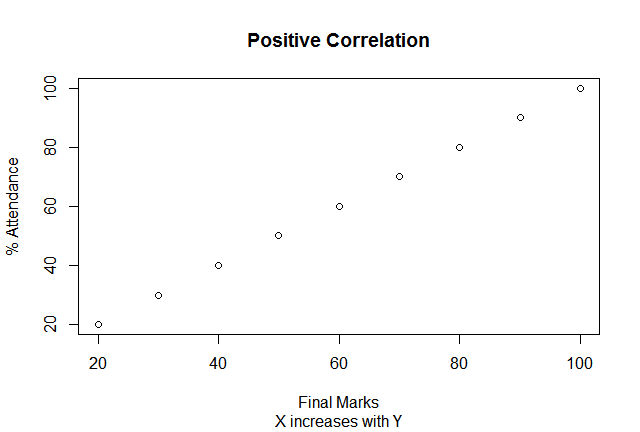
Positive Correlation
X increases with Y
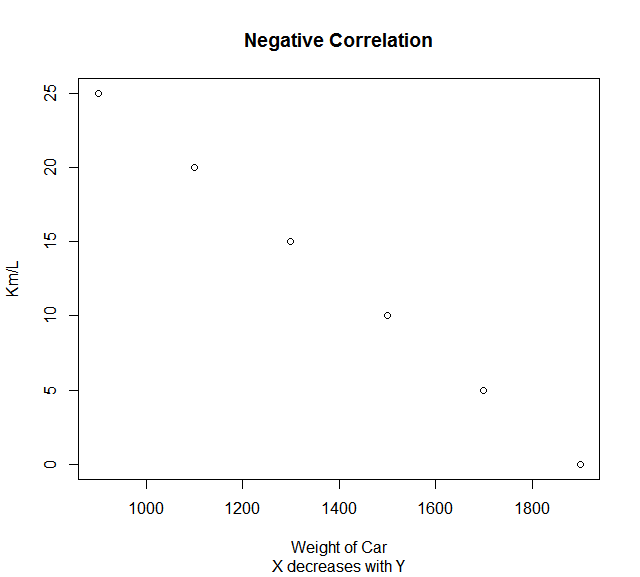
Negative Correlation
X decreases with Y
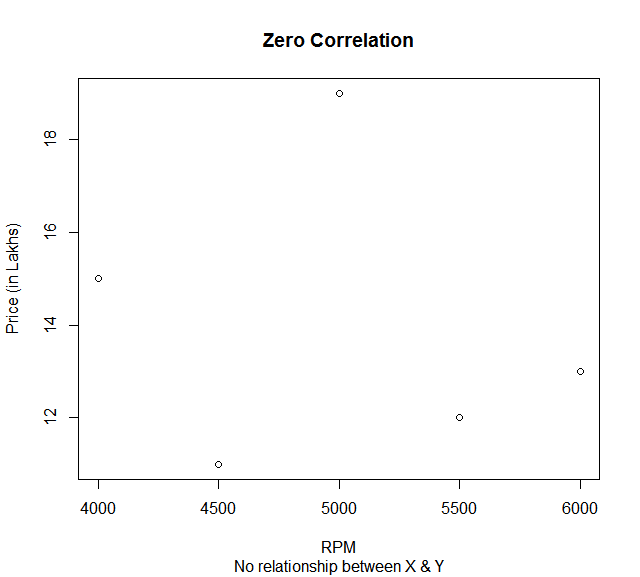
Zero Correlation
No relationship between X & Y
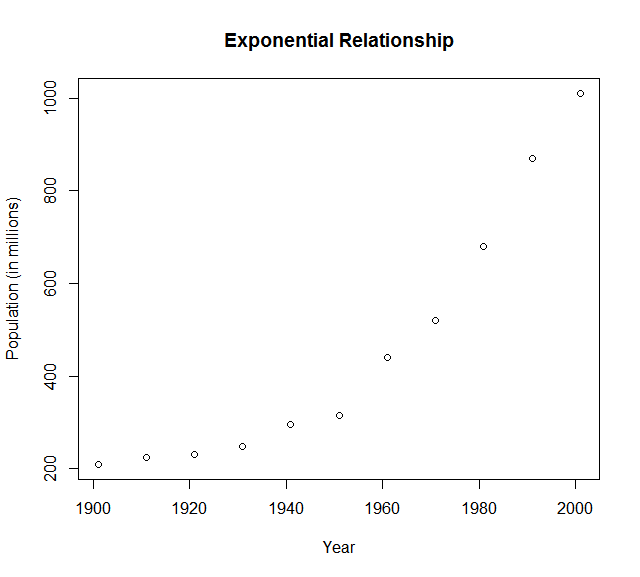
Exponential Relationship
Measuring Correlation
- Pearson’s Coefficient of Correlation
- Spearman’s Rank Correlation
Pearson’s Coefficient Of Correlation
- Represented by ` r `.
- Measures the strength and the direction of linear relationship between two variables.
- The direction of the relationship is measured by the sign of the correlation (
+or-).- A positive correlation means that the two variables tend to change in the same direction; as one increases, the other also tends to increase.
- A negative correlation means that the two variables tend to change in opposite directions; as one increases, the other tends to decrease.
- Assumes both variables to be normally distributed.
- Its value vary between (
-1to1)-1indicates perfect negative relationship,+1indicates perfect positive relationship,0implies no relationship in data.
- It is not a measure of causality.
Measuring Correlation
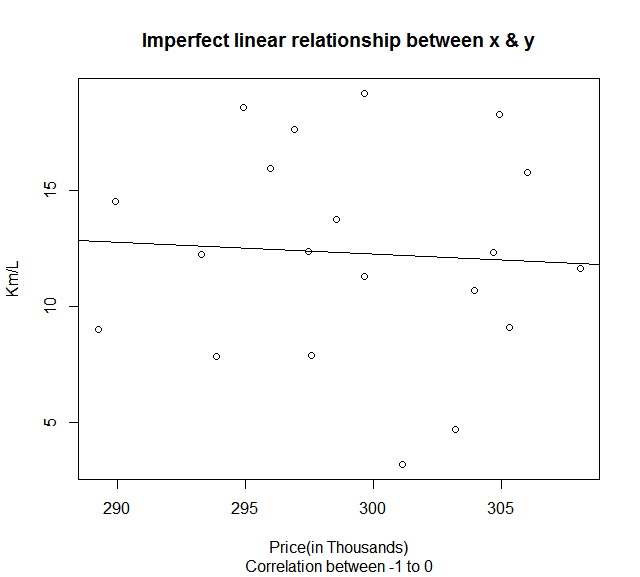
  > x <- rnorm(20, mean=300, sd=5)
  > y <- rnorm(20, mean=12, sd=4)
  > plot(x, y,
      main="Imperfect linear relationship between x & y",
      sub="Correlation between -1 to 0",
      xlab="Price(in Thousands)", ylab="Km/L")
  > abline(lm(y ~ x))
  > cor(x, y, method="pearson")
  [1] -0.06129544
  >
` r = (n sum xy - sum x sum y) / ( sqrt(n sum x^2 - (sum x)^2) sqrt(n sum y^2 - (sum y)^2))`
Example
-
Relationship between age of a car and the distance it covers before stopping.
Car Age (in Months) Distance covered during 40 km/h to 0 (in Meters) A 9 28.4 B 15 29.3 C 24 37.6 D 30 36.2 E 38 36.5 F 46 35.3 G 53 36.2 H 60 44.1 I 64 44.8 J 66 47.2 -
Calculating pearson’s correlation coefficient
` X ` ` Y ` ` X^2 ` ` Y^2 ` ` XY ` 9 28.4 81 805.56 255.6 15 29.3 225 858.49 439.5 24 37.6 576 1413.76 902.4 30 36.2 900 1310.44 1086.0 38 36.5 1444 1332.25 1387.0 46 35.3 2116 1246.05 1623.8 53 36.2 2809 1310.44 1918.6 60 44.1 3600 1944.81 2646.0 64 44.8 4096 2007.04 2867.2 66 47.2 4356 2227.84 3115.2 ` sum ` 405 375.6 20203 14457.72 16241.3 -
Plugging the values into the forumla
` r = (10 * 16241.3 - 405 * 375.6) / ( sqrt(10 * 20203 - (405)^2) sqrt(10 * 14457.72 - (375.6)^2) ) `
` r = .89 `
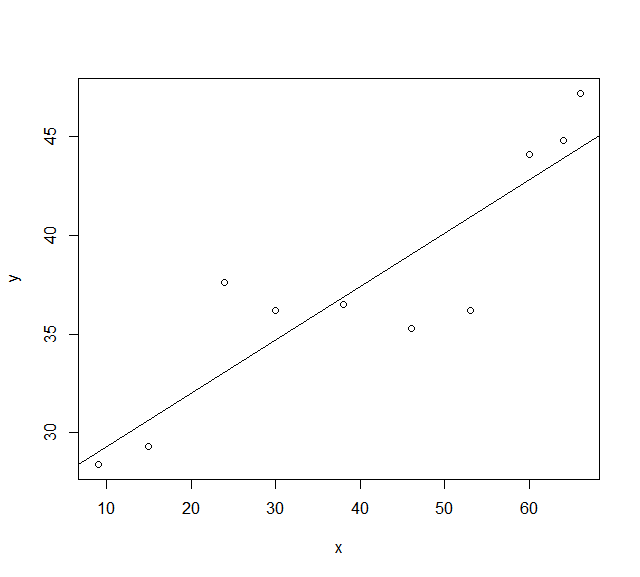
- Plot of the data
  > x <- c(9,15,24,30,38,46,53,60,64,66)
  > y <- c(28.4,29.3,37.6,36.2,36.5,35.3,36.2,44.1,44.8,47.2)
  > plot(x,y)
  > abline(lm(y ~ x))
  > cor(x, y, method="pearson")
  [1] 0.8923964
The Spearman’s Rank Correlation
- Represented by ` rho `.
- Measures the strength and the direction of monotonic relationship between two variables.
- Unlike Pearson’s coefficient both variables don’t have to be normally distributed.
- Its value vary between (
-1to1).-1indicates perfect negative relationship+1indicates perfect positive relationship0implies no relationship in data.
- It is not a measure of causality.
- It is generally used to measure the rank relationship, not the actual relationship. e.g percent measures actual marks while percentile measures rank.
- It can’t be used if the ranks are tied.
Monotonic Relationship
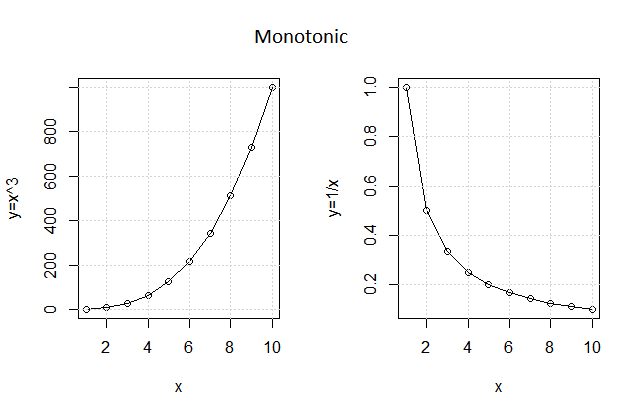
A monotonic relationship is a relationship that does one of the following: 1. as the value of one variable increases, so does the value of the other variable 2. as the value of one variable increases, the other variable value decreases
> x <- 1:10
> f <- function(x) x^3
> y <- f(x)
> par(mfrow=c(1,2))
> plot(x, y, type="o", ylab="y=x^3")
> grid()
> f <- function(x) 1/x
> y <- f(x)
> plot(x, y, type="o", ylab="y=1/x")
> grid()
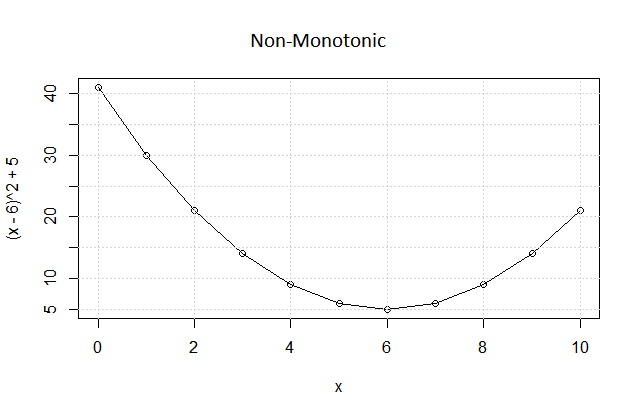
> x <- 0:10
> y <- (x-6)^2 + 5
> plot(x, (x-6)^2 + 5, type="o")
> grid()
Testing whether X and Y follow Normal Distribution
- Draw a histogram of
Xvalues, i.e. x values on X-axis and frequency on Y-axis. Connect the middle points of the bars with a smooth curve - Draw Mean of
Xon the same plot. Xis normal if the the curve is symmetrical around mean and has a bell shaped curved- Repeat steps 1 to 3 for
Yvalues
Important - Pearson’s correlation coefficient can be used if and only if both
XandYfollow normal distribution.
-
Example 1
-
A study was conducted on 303 people to find a relationship between rest blood pressure and cholesterol level. Can we calculate Pearson’s coefficient of correlation between the two?
Rest BP Frequency 91-100 2 101-110 18 111-120 40 121-130 75 131-140 70 141-150 46 151-160 26 161-170 13 171-180 8 181-190 3 191-200 1 201-210 1 Cholesterol Level Frequency 126-150 5 151-175 11 176-200 34 201-225 58 225-250 68 251-275 52 276-300 31 301-325 27 326-350 9 351-375 3 376-400 1 401-425 3 426-450 0 451-475 0 476-500 0 501-525 0 526-550 0 551-575 1 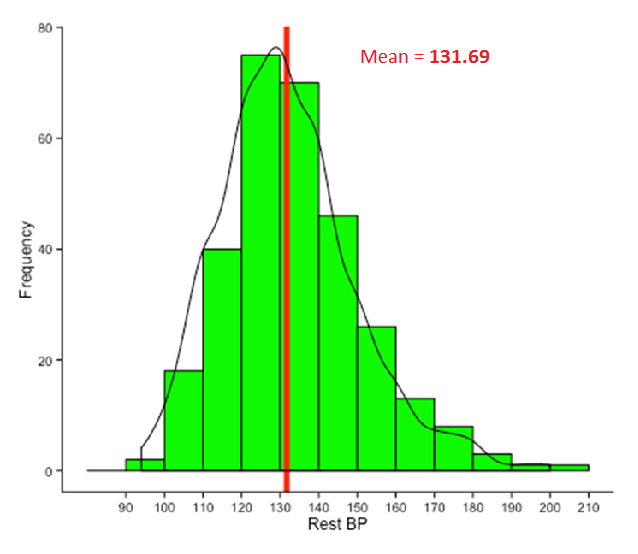
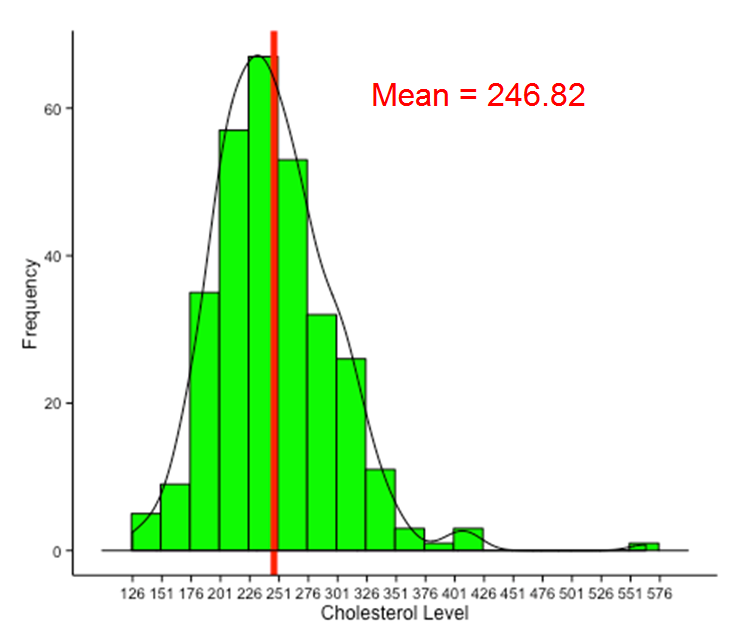
In this example we can see both
XandYfollow normal distribution, therefore Pearson’s correlation coefficient can be calculated.
-
-
Example 2
- A study was conducted on 99,000 facebook users to find a relationship between friend count and time on facebook(tenure). Can we calculate Pearson’s coefficient of correlation between the two?
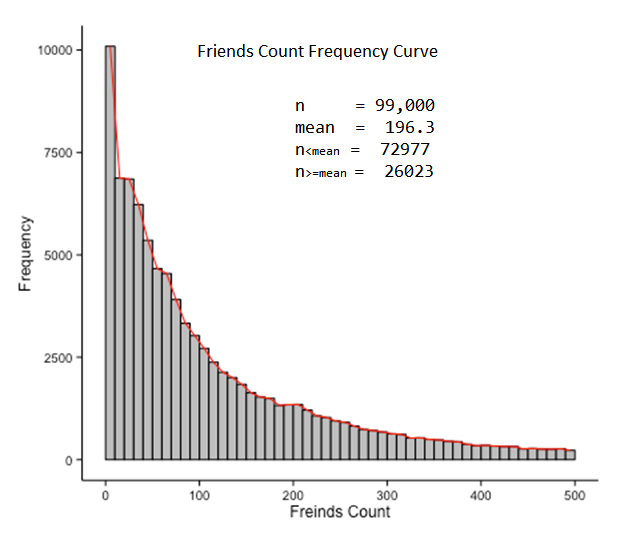
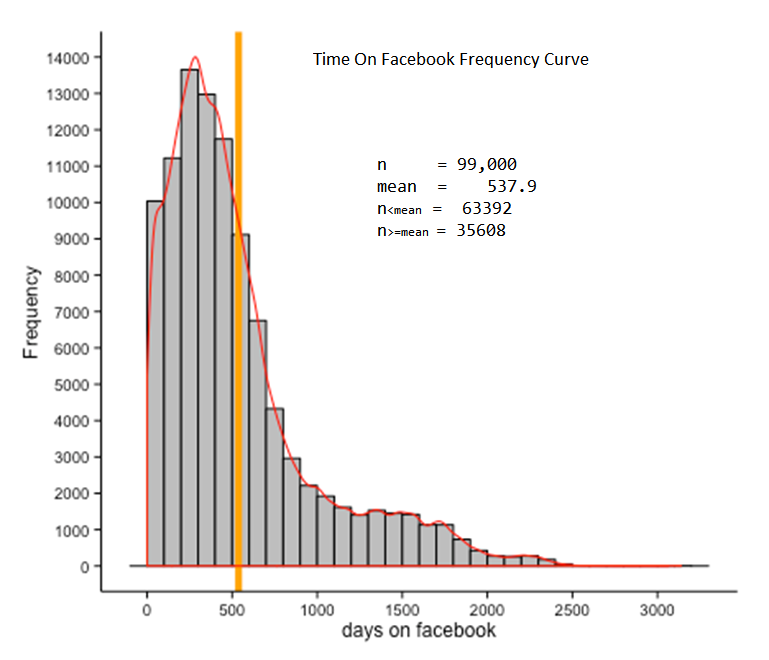
We can see neither “Friends Count” nor “Time on Facebook” follow a normal distribution therefore we can’t calculate Pearson’s Coefficient of Correlation for the given data.
The Spearman Correlation
- Scores of students in English and Maths in GMAT
  English 56  75  45  71  62  64  58  80  76  61
  Maths   66  70  40  60  65  56  59  77  67  63
-
Calculating Spearman’s rank correlation coefficient
- Calculate ranks of ` x ` and ` y `, ` d ` and ` d^2 `
` X ` ` Y` ` rank(x) ` ` rank(y) ` ` d = rank(x) - rank(y) ` ` d^2 ` 56 66 9 4 5 25 75 70 3 2 1 1 45 40 10 10 0 0 71 60 4 7 -3 9 62 65 6 5 1 1 64 56 5 9 -4 16 58 59 8 8 0 0 80 77 1 1 0 0 76 67 2 3 -1 1 61 63 7 6 1 1 ` sum d^2 = 54 `
-
Spearman’s Rank Correlation formula
` rho = 1 - ( (6 xx d^2) / (n xx (n^2 -1)) ) `
` rho = 1 - ( (6 xx 54) / (10 xx (10^2 -1)) ) = 1 - (324/990) = 0.67 `
Rank correlation for tied Ranks
    EMP                  1  2    3   4   5   6   7   8   9  10
    Height (in inches)  62  68  66  70  74  61  70  70  65  64
    Weight (in kgs)     55  62  66  68  80  57  67  75  64  63
- write down the ranks of Height and Weight in usual manner. You can assign ranks 2,3, & 4 to 70 in any order.
| Height | Weight | rank(` x `) | rank(` y `) |
|---|---|---|---|
| 62 | 55 | 9 | 10 |
| 68 | 62 | 5 | 8 |
| 66 | 66 | 6 | 5 |
| 70 | 68 | 2 | 3 # tie |
| 77 | 80 | 1 | 1 |
| 61 | 57 | 10 | 9 |
| 70 | 67 | 3 | 4 # tie |
| 70 | 75 | 4 | 2 # tie |
| 65 | 64 | 7 | 6 |
| 64 | 63 | 8 | 7 |
- take mean of ranks of
70. e.g. in our example the mean would be ` (2+3+4)/3 = 3 `. we are dividing by3because70happens to be three times.
| Height | Weight | rank(` x `) | rank(` y `) |
|---|---|---|---|
| 62 | 55 | 9 | 10 |
| 68 | 62 | 5 | 8 |
| 66 | 66 | 6 | 5 |
| 70 | 68 | 3 | 3 # tie |
| 77 | 80 | 1 | 1 |
| 61 | 57 | 10 | 9 |
| 70 | 67 | 3 | 4 # tie |
| 70 | 75 | 3 | 2 # tie |
| 65 | 64 | 7 | 6 |
| 64 | 63 | 8 | 7 |
Rank Correlation formula for Tied Ranks
` rho = (n sum x_r y_r - sum x_r y_r) / ( sqrt(n sum x_r^2 - (sum x_r)^2) sqrt(n sum y_r^2 - (sum y_r)^2) ) `
` rho = (10 ** 376 - 55 ** 55) / (sqrt(10 ** 383 - 55^2) sqrt(10 ** 385 - 55^2)) = 0.90 `
Note - ` x_r ` and ` y_r ` are the ranks of ` X ` and ` Y `
Comparison of correlation coefficients
| Pearson | Spearman | Rank For Tied Ranks |
|---|---|---|
| 1. Variables ` (x, y) ` have to be normally distributed | Variables ` (x, y) ` don’t have to be normally distributed | Variables ` (x, y) ` don’t have to be normally distributed |
| 2. Linear relationship between variables ` (x, y) ` | Monotonic relationship between variables ` (x, y) ` | Monotonic relationship between variables ` (x, y) ` |
| 3. Measures relationship between actual values | Measures relationship between Ranks | Measures relationship between Ranks |
| 4. | Cant be used if ranks are tied. | Is used when ranks are tied. |